
The ski movie
or rather skiing—and my dad’s early career—as they relate to films commissioned for the Olympics.
There is such a thing as the ski movie, which first emerged as the instructional, documentary mode of filmmakers like John Jay and Warren Miller, who released “annual” ski films and who traveled a circuit of resort towns to present them as “lectures,” which I think means the films mainly offered instruction on technique. Miller pumped out the pictures, but the format is not well remembered, perhaps because, as noted in the Skiing Heritage Journal, it has already accomplished the specific—and not very cinematic—aim of getting Americans interested in the sport. One project my dad worked on is a television program called The Killy Challenge, which featured the French superstar skier Jean-Claude Killy competing “head-to-head” (meaning side by side) against local competitors in towns like Jackson Hole and Heavenly, Nevada. I couldn’t find a record of the show except as listed in an old TV guide.
Skiing has been filmed as an answer to cultural phenomena like The Endless Summer: that would be The World on Skis, which my dad shot most of, which he has loaded into a 16-millimeter projector at home and screened for me before. Locations include the classical (St. Anton in Austria) and the unexpected (Mauna Kea in Hawaii). Or the ski crew has been parceled as a second unit on Hollywood films like The Soldier, also in St. Anton, where a cable car was blown to smithereens.
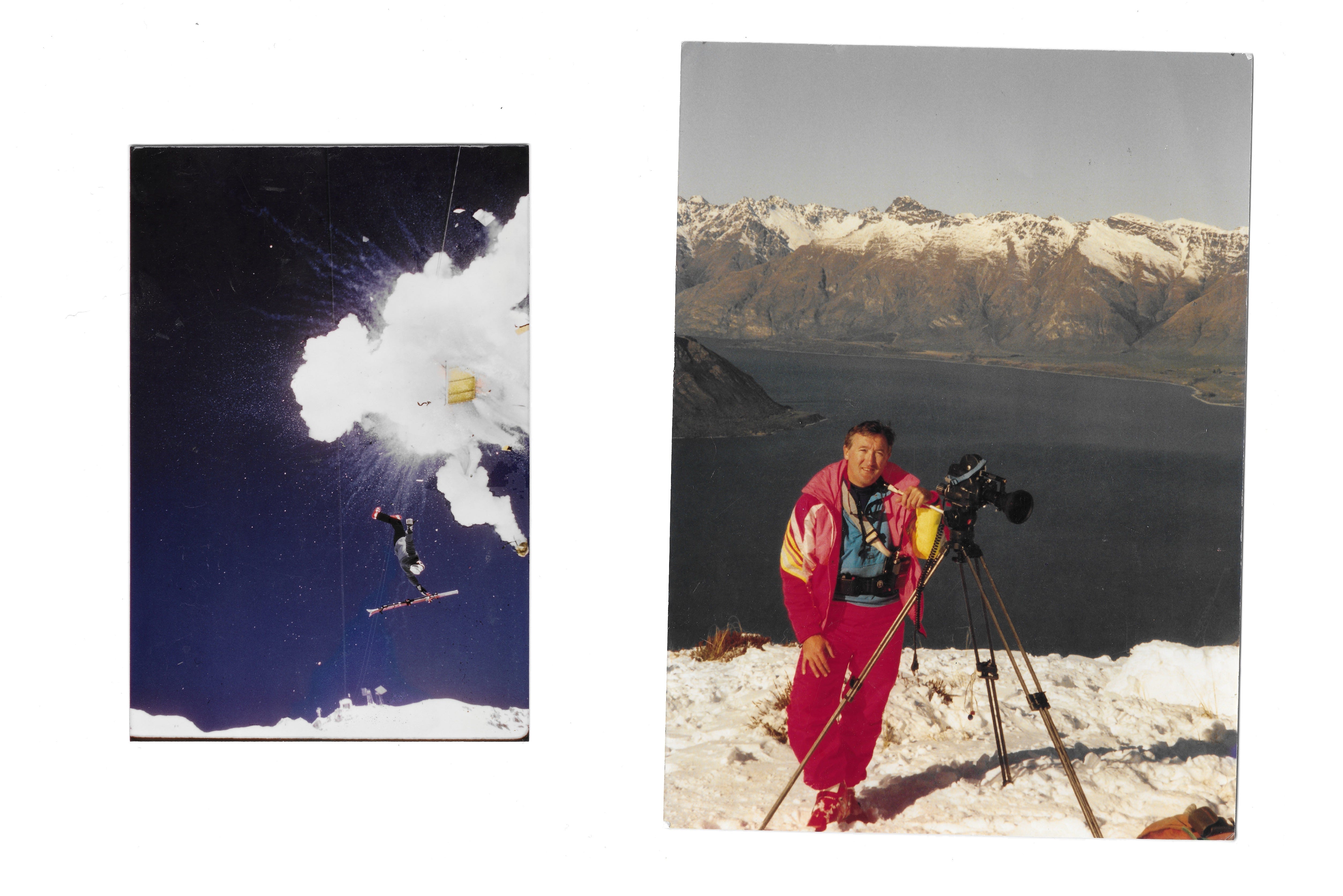
The animating principle behind being on mountains with skiers and capturing their action on film and matching the action to capture it seems to be the realization that skis and cameras just go together. A zany family friend is sure she saw my dad once glide down a mountain backwards while shooting an avalanche, which he says is baloney, but the sentiment, the certainty that my dad’s crew were superhuman maneuverers, is more important. How do you find yourself a makeshift dolly as smooth as the machine except for when you have snow? I couldn’t pin down the fates of a lot of the films my dad has mentioned, and he doesn’t keep a catalog of his credits. He cares mostly about his presence, his confirmed use of a camera, at dozens of major skiing events in the second half of the twentieth century.
I concede the difficulty of recollecting information about films produced fifty years ago, but one thing my dad has never done is narrativize his biography. He’s a piecemeal guy: you activate his memories by mentioning proper nouns in passing, which unlock key details you can link together into an origin story, and then the story of the rest of his career. To this end, and despite it being an imperfect vehicle for remembrance, my sister and mum and I bought my dad a box set of every “Olympic film,” a collection comprehensively restored by the International Olympic Committee and distributed by the Criterion Channel.
Why imperfect? Because ski films and Olympic films are distinct species. The concept of the Olympic film is hard to pin down, a bit insistent on—and defensive about—its own existence, outside of a duty to document. And in fact that documentation, as with the ski movie, was a practical tool for the judges, coaches, and data analysts at the games, at least until the development of more customized technology. In the London Review of Books David Goldblatt explains how, from the “willfully romantic” inception of the modern Olympic games by Pierre de Coubertin, the IOC has fought to manufacture relevance, first by including popular sports, i.e. attracting the working class—and blunting nationalistic associations—then by allowing women to participate, then by dropping its ban on professional athletes, which allowed American basketball players to go to Barcelona in 1992 and drive up viewership. Then, because the newfound absence of amateurism created an “ideological void,” the IOC staked a claim to liberal-progressivism, introducing commitments to “human rights, gender equity and the pursuit of environmental sustainability.”
This shapeshifting relationship with athletic scope speaks to the erratic and even flimsy motivations for re-founding the games back in 1894, even though now it makes sense (I guess?) that one gargantuan event should pit countries against each other through sport. Rule 27 of the Olympic Charter is that “each organizing committee must make a film record of its games,” according to the coffee table book that accompanies the Criterion set, which reads as a sign that the IOC figured to lean on filmmakers and help them stick together the verbiage and organization of elements and balance that could define the games. It helped that the Lumière brothers invented cinema literally a year after Coubertin’s Olympics started, thus Olympic narrative development could be invigorated by the more organic exploration of a transformational new medium.
In 1999, Chris Vanocur, a reporter for ABC’s Salt Lake City affiliate, broke the news that the city, due to host the 2002 Winter Olympics, had bribed IOC officials to win its bid. The scandal led to the discovery of either dubious transactions or “criminality” involved in almost every bidding process dating back decades. Goldblatt writes that the 2014 Sochi games, which cost $51 billion, were “primarily an instrument for transferring some of the Russian state’s hydrocarbon money to oligarchs and their underlings.” Killy, an Olympic nut whom Sports Illustrated once called a potential IOC president, complained of Putin being “unfairly treated,” and that he and the despot were “very good friends.” (Putin is known to be a great skier.) Goldblatt wonders if the whole Olympic enterprise might eventually and deservedly fall by the wayside.
As far as the winter games go: what if we kept only the skiing? No knock on the other sports, speed skating’s cool and bobsleighing has the vessels destined to show up in your dreams, but then there’s figure skating, which Ipsos reckoned was the most popular sport at the Beijing winter games in 2022 by a wide margin, but I wonder (without evidence) whether this engagement is not one of the main byproducts of the IOC’s confection campaign. The costumes! The drama! Why are they all married couples! Killy may be forgiven for a tunnel-vision dedication to getting the games on their feet, of knocking aside the ever-insurmountable logistical challenges that accompany a bid, given that he fitfully and almost single-handedly secured France the 1992 games in Albertville. And Albertville itself was the full-circle home-turf moment for Killy, then the veteran nearly thirty years removed from his formative Olympics in Grenoble in 1968, where he won three gold medals.
It is because my dad’s movements in this period crossed over with Killy’s that my writing on skiing will focus on Olympic films from Grenoble and from Albertville, as well as from Innsbruck in 1964. Together the three films work both to help me access the first big steps in my dad’s path through the ski film industry and to understand some part of how the artistry of filmed skiing developed and soared, before it frayed, got confused, infiltrated by consumer tech and user-generated content and sumptuous broadcast coverage.
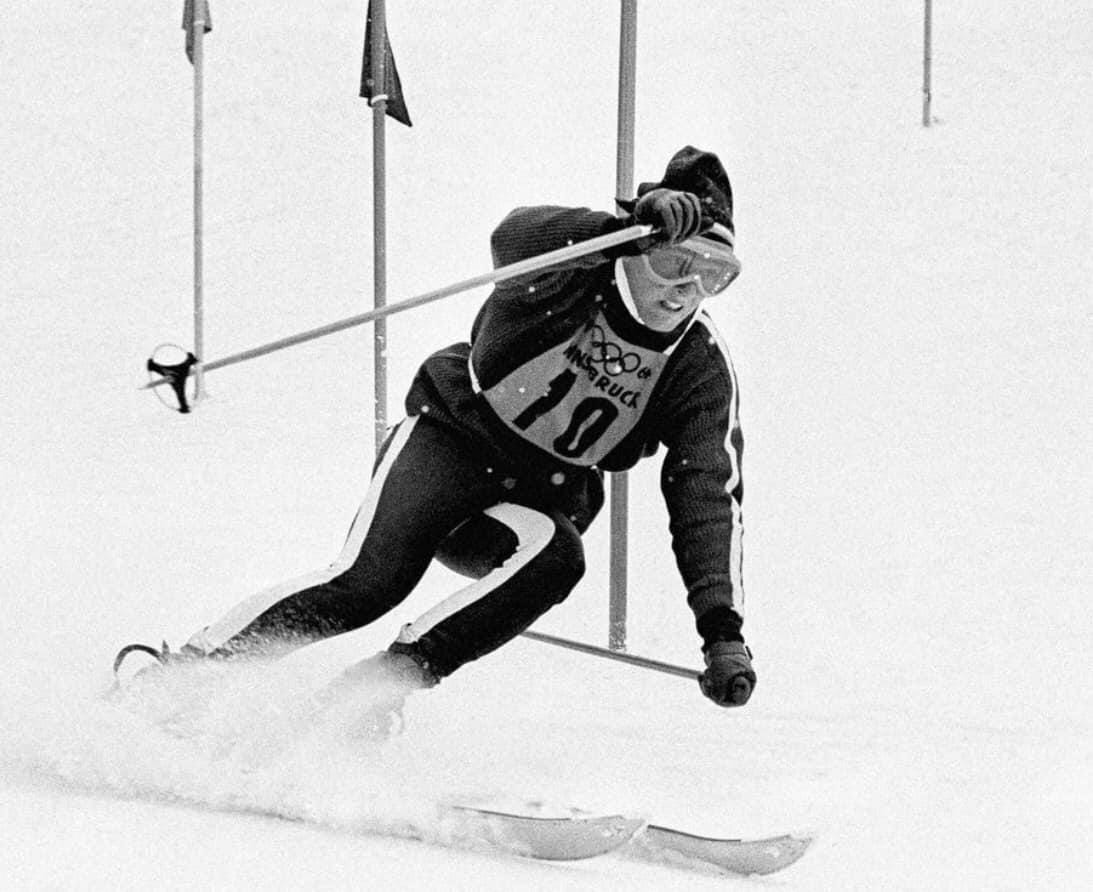
Innsbruck is a wonderful Olympic setting and a charming Olympic film because these games occupy (the back end of) a limbo state between the Olympics being provincial and the Olympics being a lucrative technicolor spectacle. Killy had joined the French ski team in the early sixties but, as his coach Honore Bonnet put it, in those days he “never finished a race.” Innsbruck is still probably an environmental ideal for the concept of accessible spectatorship (almost absurdly so) and can-do perseverance on the part of the organizers. Maybe Killy always wanted to go big (he would make so many ads), but he also grew up skiing over rooftops in a village in the alps.
The official Innsbruck film, directed by the Austrian Theo Hörmann, structures a conventional account of the games, interpolating cultural facts about the Tyrolean region (Olympic films are somewhat obligated to spotlight the host city) and telling us the significance of pretty much everything on screen, either helpfully or pedantically, depending on your tolerance level. Are there some mistranslations from the German narration? Billy Kidd, who won a silver medal in the slalom (and who once stayed with my parents in London!), is described as a “carefree loser” with “nothing to lose.” My favorite line was the declaration that the goal of the Olympics is “perfection,” which lands despite the self-seriousness as shameless—and accurate. Indeed the breathless IBM product placement reminds us how in 1964 the firm’s analysts call contests at the smallest fraction of a second. Cutaways to IBM offices hundreds or thousands of miles from Innsbruck—tiny people pressing buttons—put me in mind of Inside Out.
But clearly the nerds can’t do everything, because in 1964 judges were still using cameras to check skiers’ finishing positions in the frames of film rolls. And in one lovely sequence Hörmann throws an arced line on screen, like it’s a slide in a PowerPoint presentation: this line is superimposed over the bobsleigh route, and we learn how if racers fall below it they’re guaranteed to lose. Experimentation hovers at the edges of Hörmann’s mandate, but we are treated to weird kaleidoscopic double-images, where a closeup of an athlete’s face in one corner of the frame bleeds into a wide-angle shot of a crowd. There’s no explanation for this choice, but hey, why not try it out?
The most flabbergasting things about Innsbruck are that spectators didn’t need tickets and that mere weeks before the games the city had no snow. The army was called in to transport powder from nearby villages; as observed in a contemporary Times article, “hundreds of Austrian soldiers clambered over the hillsides, packing them by hand with snow…hauled up the ski tracks in wooden sleds.” Counterproductively, it’s Tyrolean custom to blow a horn from the top of a mountain to ward off harsh winters, which Hörmann shows the Tyroleans doing, could you stop that please!! And then there are the teenagers on their cross-country skis ambling from their homes along narrow pistes to greet their heroes in the middle of a race, basically at arm’s length. At one point the camera fixates bizarrely on a steep section of mountain where standing onlookers lined up in rows keep losing their balance and falling, quite dangerously, down the slope, sometimes bowling over as many as five or six others in the process. Can you imagine a sporting infrastructure that barely accounts for the people watching the sports, which actually means giving them total freedom? How would you feel about total freedom as a spectator?
By 1966, two years after Kidd’s medal and victorious Innsbruck performances by skiers like the Austrian Pepi Stiegler, Killy was a minor celebrity winning a lot of races. 1966 is also the year that my dad left his hometown of Edinburgh to intern on a cattle ranch in Argentina. I already knew this part of his story: he loved skiing and wanted to squeeze in a trip to Portillo, Chile, a mountain that bottoms out on a small lake and striking yellow hotel. The owner of the hotel was impressed enough by my dad’s abilities that he offered him a job on ski patrol, so my dad delayed his arrival at the ranch. Early in the season he broke his leg, which was a huge bummer but not a dealbreaker for employment at the hotel, which also had a pool, a discotheque and a cinema. For the whole season he worked simultaneously as a projectionist, a lifeguard and a DJ. There is no triptych I’m more obsessed with.
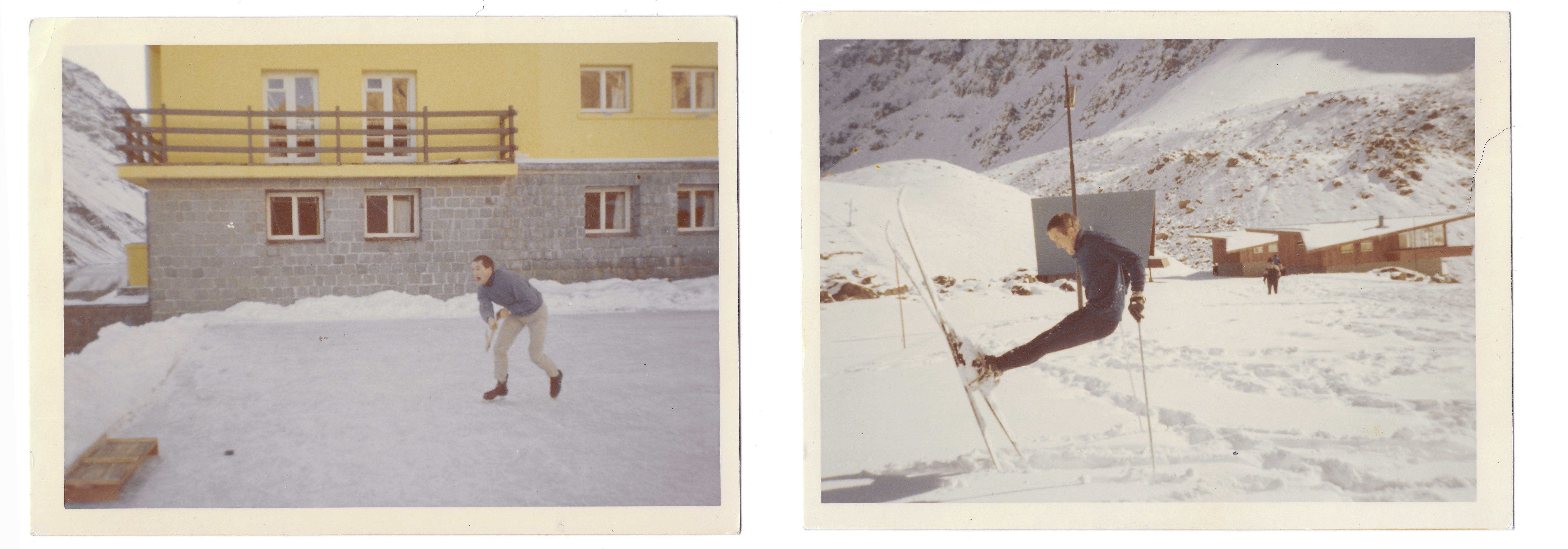
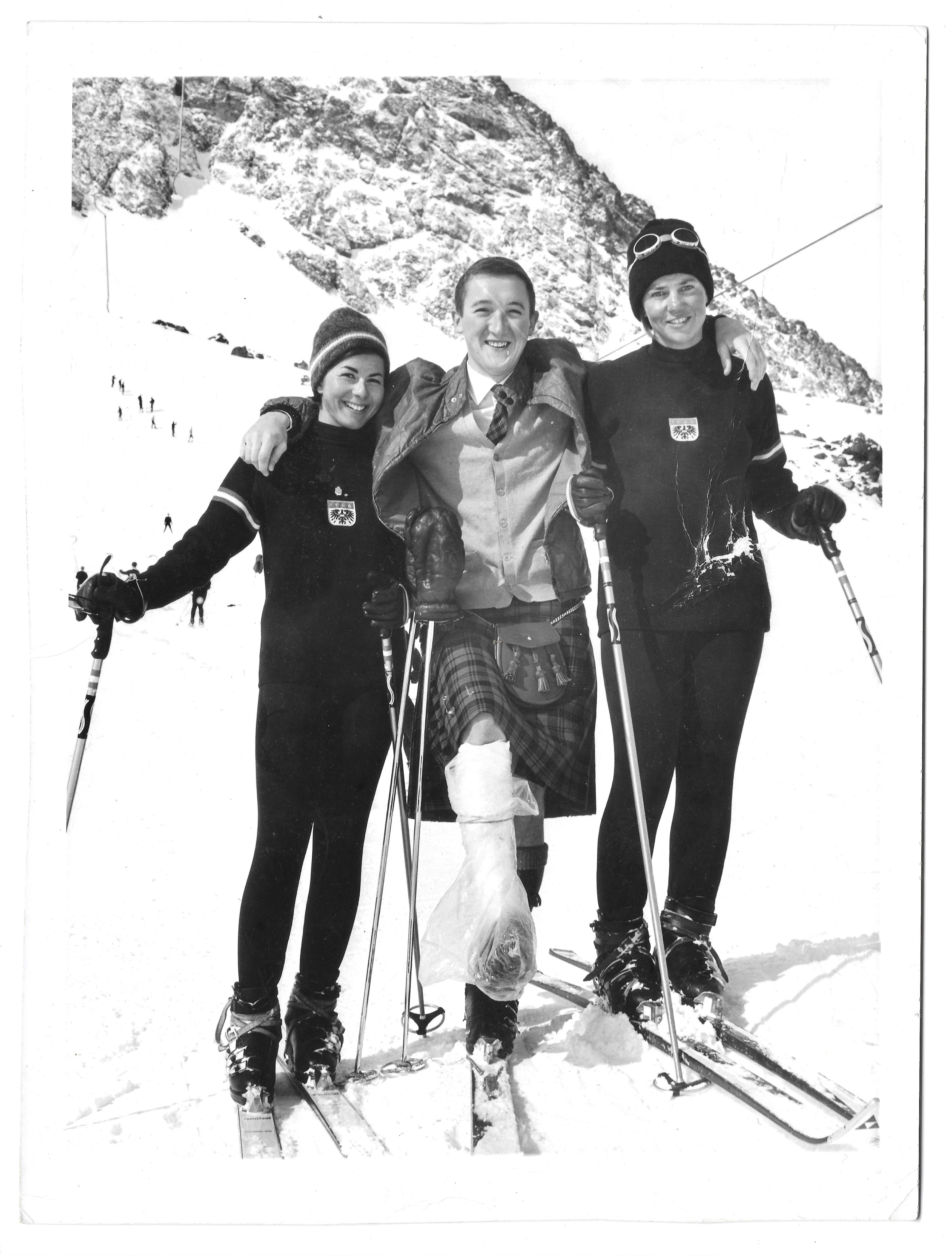

Extending his stay in Portillo meant that my dad was in town when the Alpine World Skiing Championships descended there that August. The event was so fateful for his future that I’m almost moved to tears by the knowledge that it might not have happened that way. Portillo is where Killy won his first downhill race, where he set the stage to dominate the next winter games. It’s where my dad went out on the mountain—in a kilt, to flaunt his heritage and spare his broken leg, but he was still on skis so…not so spared; his photo was taken with athletes and ran in The Scotsman back in Edinburgh, where his parents saw the photo and learned of his injury for the first time.
Most consequentially for my dad, Portillo is where he ran into Dick Barrymore, a ski filmmaker who modeled his approach on Warren Miller’s and who was on hand to shoot the championship’s official film. There is a brilliant photo from Portillo of Stiegler, the Innsbruck gold medalist, to whose helmet Barrymore jerry-rigged a camera and a counterweight with bungee cords and duct tape for a POV shot. Cameras fixed to surprising objects so that they bulge and glisten is like the best form of camera-awareness, of cameras bursting into a composition, into a worldview, mercifully (though inevitably) spotted by others of their kind.
Dick and my dad had met at Aviemore, a Scottish resort town, and in Portillo Dick told my dad he should come to California. He would then ask my dad to Grenoble to help him shoot the 1968 Olympics, where he was not commissioned by the IOC (as my dad said, the Olympics do extend beyond skiing) and not technically permitted to shoot the races, but he wanted to use Grenoble material for his own not-exclusively-Olympic ski film. My dad went to Grenoble with a Kodak K-100 camera alongside five other videographers including Dick; the group called themselves the “Dirty Half-Dozen,” a name I had thought applied to work on multiple gigs, but it was just this one. Dick wore disguises so that he would not be recognized by officials. Meanwhile the French director Claude Lelouch, fresh off a Palme d’Or win at Cannes for A Man and a Woman, would shoot Grenoble’s official Olympic film with Éclair Caméflexes, the same that Godard used for Breathless.
My dad had never used a motion-picture camera before Grenoble. It was his first job in charge of one. He had been bound for a cattle ranch, and was introduced to the idea of filming skiers while on skis, an idea I associate with the resorts of North America and Europe, in the far reaches of the Southern Hemisphere. I don’t think he’d considered the possibility of such a job before this moment. And before this month I had not linked these parts of the story together.
In two weeks’ time I will return to 1968 and to Lelouch’s film 13 Days in France, which is a “personal project,” a recutting of the footage he used for Snows of Grenoble, the official Olympic commission (which he did not direct). 13 Days in France is a container for transcendent images and for awestruck yet also probing observation of all the corners of Olympic infrastructure and participants and strangeness. And while Lelouch’s team watched and rolled in the wings…so did my dad’s. At the center of everything is Killy, whose overnight fame will lead to my analysis of One Light, One World, one of two official winter Olympic films where my dad was credited as a producer, which covers the Albertville games that Killy spearheaded and which occupies a drastically different visual mode than Lelouch’s Grenoble.
This writing will be interrupted by next week’s thoughts on the Oscar nominations.
JANUARY 30 UPDATE: JUMP TO THE NEXT installment of this story now that it’s been published.
Have you missed a recent Fergstack?
Catch up on last week’s writing about Disney’s ingenious (or stolen!) multiplane camera.
♡♡♡♡♡♡♡♡♡♡♡♡♡♡fergstack.substack.com♡♡♡♡♡♡♡♡♡♡♡♡♡♡♡♡♡♡♡