
The ski movie (part II)
mostly concerning "13 Days in France," Claude Lelouch's Grenoble epic.
In 1990 the French skier Jean-Claude Killy told Sports Illustrated he “always believed that skiing was something serious.” He knew good skiers growing up in Val-d’Isère, an idyllic alpine village, including a dude named Gerard, who was better than him but didn’t understand how skiing “could actually form your life.” This is a remarkable way of explaining dedication to a sport, especially given that Killy spoke in English (a language I bet he mastered to more seamlessly become a star), which does not immediately ensure an understanding of the belief in practice, if it does not merely mean being a world-class competitor and three-time Olympic gold medalist, also known as structuring one’s schedule around events, benchmarks, record-beating. People who do this commit as tweens and rarely possess the vocabulary to encapsulate a narrowness of purpose that hinges on honing a skill until you’re on the verge of defying physics or until you tear your ACL.
But formation might indicate there’s something in the style of skiing that tells you how to react to all experiences—how to self-express. I was searching for evidence of this influence as I watched 13 Days in France, the Claude Lelouch-produced film that covers the 1968 Winter Olympics in Grenoble. As I noted in the first installment on this subject, Grenoble is where Killy left his deepest mark and also the first games attended by my dad, who had ambled around with a broken leg in a kilt in Portillo, where Killy won his first downhill race.
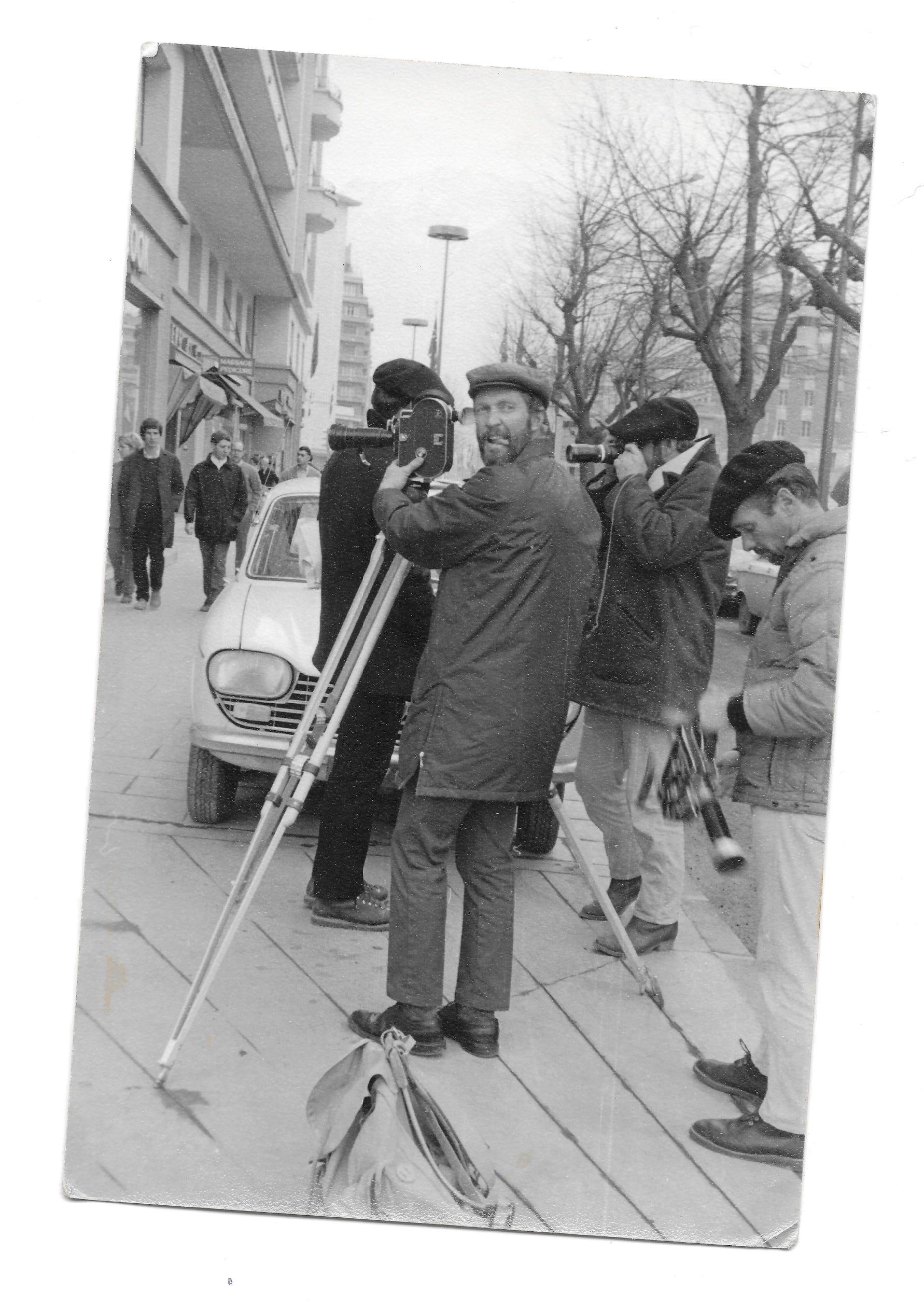
Dick Barrymore hired my dad for his first-ever camera-operating gig in Grenoble, but was effectively sneaking in, as he and the self-designated “dirty half-dozen” working alongside him did not have official clearance to shoot Olympic events. On the one hand, Grenoble was among the last Olympics attended and gatekept sparsely enough for almost anybody to stride up to a race and photograph it. But Dick wore disguises throughout the games because he knew so many officials, which meant he knew they would react badly to seeing him, and he wanted to make it out of Grenoble with some material.
Lelouch was the sanctioned sculptor of the Olympic film, but he too seems to have bristled at authorities, the specter of their oversight, as his most significant contribution from Grenoble is 13 Days in France, a side project he refashioned from original footage. The sequence of events in 13 Days is chronological enough, but Lelouch and the 28 (!) other credited directors1 weave in the exploration of parts of the Olympic apparatus that are like alleyways between thoroughfares. Spaces accumulate and allow in a pretty singular way for the spectrum of emotion the filmmakers stumble upon, the displays of curiosity, unruliness, devastation both good and bad, total focus and its inverse. The images don’t concern skiing exclusively, but skiing’s speed and form feel like the model everywhere that some kind of elevated energy is at stake.
The film starts as the Olympic torch is run around France, and the fixation is on the faces: moderate exertion and more notably dispassionate participation. None of the figures smile; neither do they look uncomfortable in the cold. We already sense a collective buy-in to the ritual. I personally bought in instantly, since passing off a talisman is an easy pattern, and easy to track from an adjacent car on long-ish lenses. One tightly packed ensemble rides bikes in burgundy tracksuits; a young boy’s breath billows against cold air; a runner warming up waiting for the torch sneaks in a quick smoke. The journey ends at a vast, glassy stadium, rendered glassier by the petrochemical blue in the film stock and vaster by the ultrawide lens. Nearly as fast as we’ve established an organic participatory spirit, we’ve introduced the unfamiliar (because newly constructed) and uncanny symbol of the games’ desired girth. But nobody’s here yet; what will we do when they’re gone again? (Perhaps dismantling is not out of the question. When policemen patrol the stadium, the scene resembles Fellini’s sci-fi set in 8 ½—ready to go but perforated and impermanent.)
The toggling between freckled, blushing, willing people and artificial and striking infrastructure and organization becomes constant. Dutiful men in black uniforms link arms and march down the pistes to pack them, before more dutiful men in blue uniforms further pack the piste with their skis in pizzas. This before we observe the silvery sharpness and clear edges of a chairlift mechanism, which might as well be the cogs buried within an incomprehensible industrial machine. The intent is to scene set and to marvel and maybe to develop an ethnographic pulse; we linger on Charles de Gaulle as he watches the opening ceremony, amused but not unbothered, before we watch more youths prep the bobsleigh route, a miraculous diversion from their normal existence.
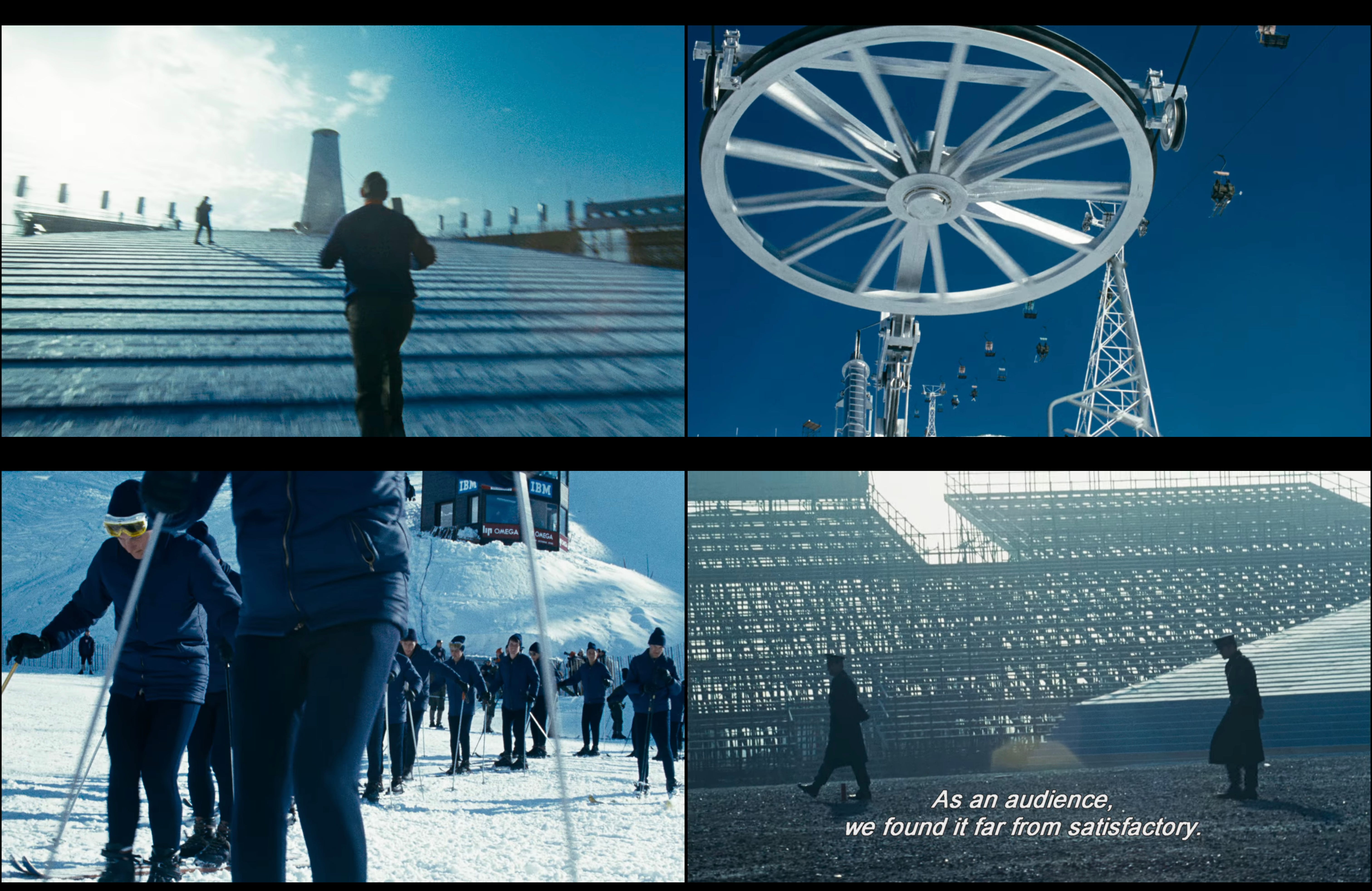
This is the most natural argument for and agent behind the survival of the Olympics, not even in the long term but literally in the twelve-day span of the Grenoble games: everybody’s, well, game. Is that what Killy meant by “form,” that sport could be a beacon, its magnetism trickling down to even the innocuous action unfolding in proximity?
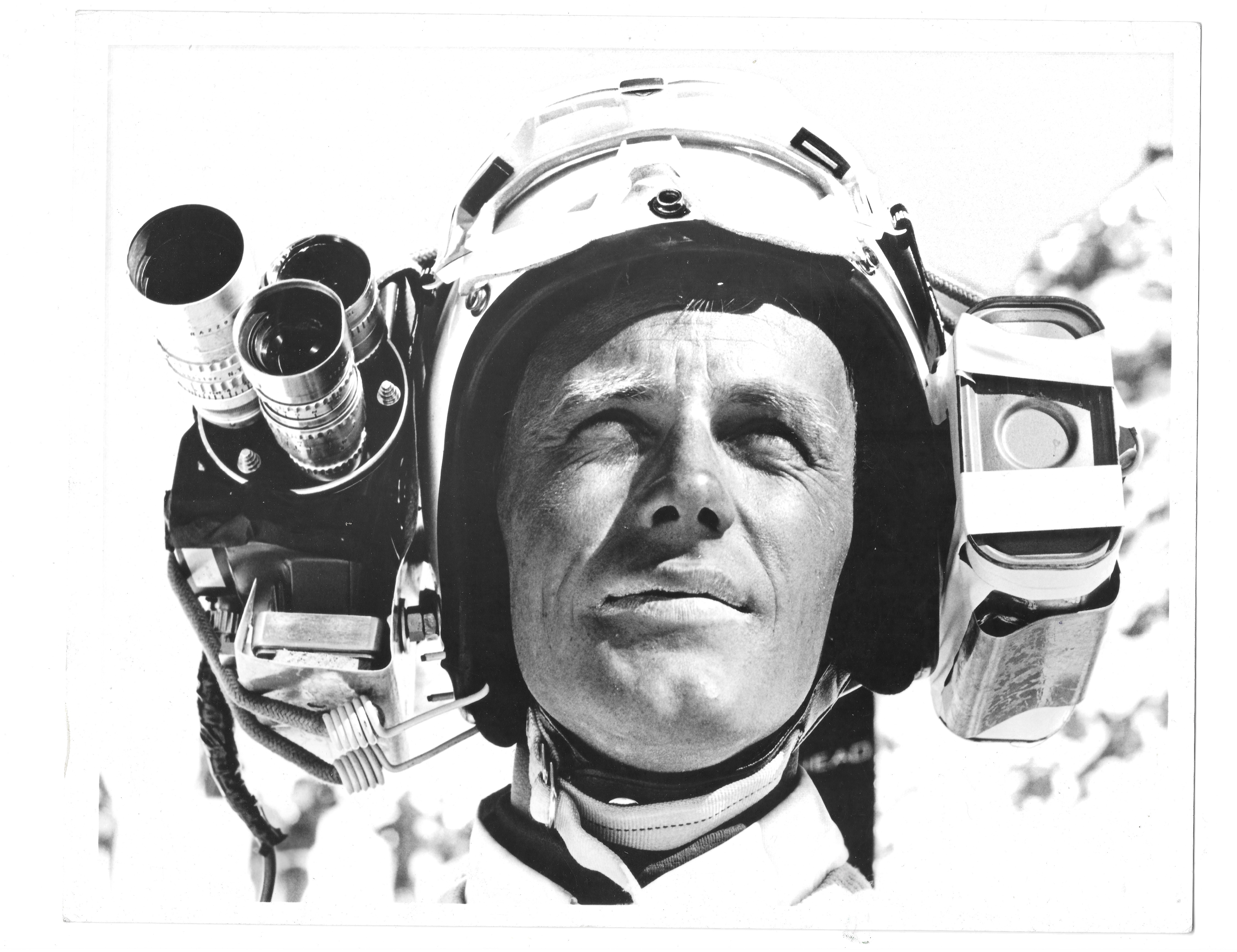
We have to wait for the skiing, but when the rest of the sports kick in the footage does heighten our sense of their generating ecosystems, dependent ones. The cinematography that the filmmakers unleash via athletic subjects has staggering verve and is more importantly weightless. I first mentioned this post’s thumbnail two weeks ago—it’s a picture of the Austrian skier Pepi Stiegler with a provisional point-of-view camera that Barrymore fixed to his helmet—but the rig is more relevant now, because Lelouch and co. make magic with it.
One of my favorite early sequences is a series of rhapsodic cuts between shots of a figure skater. We get a staid, tight angle on the skate that’s sudden sepia stock, then the sight of the rink as it whips by in POV, then that same wide-angle lens from the stadium zeroing in on a sit spin, and then another whirlwind turn, now with the skater’s fixed body anchoring the frame, one leg crossed over the other like this is a state of repose. In sepia and in color we’re under the skater, they dominate the camera, before they’re in possession of it again, and then they stop their whirlwind turn. As if to chide the viewer for thinking that motion was inevitable. No, a force was at work.
A POV shot also defines the ski races, but courtesy of a discrete cameraman who rockets from the gate in front of the competitor, in the woman’s downhill. The cameraman shoots through his legs, I mean maybe it’s not intentional but that acknowledgment of a human instrument ensuring this perspective—not that the shot feels airborne without calves or ski tips in frame—is a nice reminder of how far our mediators are willing to go to keep us with the skiers, to bring us all the way into a “world of their own.”2 At the bottom of the run we careen past spectators to zero in from a low angle on several competitors, who lean into their poles like they’re peering out over this new world.
The adrenaline rush of the downhill sets a precedent. Skiing comes into focus as the pinnacle of momentum, momentum we’ve seen bunched up in other arenas. There’s not much structure to the smattering of ski races in the remainder of the film and even so skiing’s surroundings add texture that’s fundamentally supplemental. I tried to pin my dad on whether he’d shot in POV like our daredevil operator but he said he’s only skied down unoccupied race courses (while trying to match the average racer’s speed of course, sans need for frame rate manipulation!). My dad seemed positive that a cameraman would not have been so close to a skier for a real race. Later in the film POV shots from dry runs are more transparently intercut with the competition, but here I’m not sure. Maybe the dreaminess, the further world invasion happens if we don’t interrogate context.
And all this time, I know, we have not had eyes on Killy. When we find him we’re right there next to him, we’re in the funitel on the way to the men’s downhill. But right as he heads to the gate the editors splice in filmed footage of a TV playing the race, which would be formally cool if we weren’t so hooked on the intimacy moments before. The reason for the omission is probably footage loss or a logistical hang-up, but it nevertheless prevented me from assigning Killy’s invocation of form to just his technique. Skiing is already so stylish that beyond a certain skill level it’s clear you’re making marginal adjustments to win—or inventing new tricks, as Killy did with his catapult jump, “which gave him as much as a half-second advantage over racers who used the conventional starting style.”3 My god, that’s happening before the skis touch snow!
Lelouch’s world coheres and coheres, has split off entirely from the land mass that’s the world I know. Experts sharpen bobsleigh blades in the middle of the night and again in sepia (the two stocks are so opposed it’s like some kind of reaction is being provoked by their correspondence), before races that mix the dusky with the nocturnal, we’re not sure how far apart they are. Revelers chug oversized jugs of lager in an oversized beerhall (sepia, ultra-wide) and laugh at the camera and do this bit where they leap up and sit down and leap up and sit down in unison. Perhaps most evocatively we watch slalom competitors with their eyes closed turning their hands through the air. The route’s been set but imagination is required, in fact in ample supply. It dovetails with the suspicion that you could shape this world to your liking.
Barrymore and his team had nothing to do with Lelouch’s images, but I had a fun time picturing my dad at the same races, focused on a narrower band of matter: if skiing is the pinnacle can we disregard the rest? Barrymore tried to smuggle out a piece of the world that Lelouch liked whole in service of his own. In the fall of 1968 in New York, Barrymore screened a new ski movie (I wish I knew the name!) which included races from Grenoble. As my dad recalls, a representative of the French tourist office saw the movie and assumed this was the official Olympic film, later waxing lyrical about it to a colleague. Lelouch’s picture had not been released yet, and Barrymore was served an injunction. New York was the last place he played that movie in a theater.
I wrote in the first part of this story how my dad was more concerned with being present to record a race than with the fate of the projects that would contain his footage. This seizure and disappearance of an illicit Barrymore flick he had contributed to felt like the cartoonish apex of that priority. Surely my dad did not grow tired of his trademark practice, his “matching the action to capture it” (that’s a self-quote), but what about the containers?
One Light, One World is the official film of the 1992 Olympics in Albertville, a town that had no standing before Killy and a business partner became obsessed with the idea of bringing the games back to the French alps and mounted a long-shot campaign. It is with Killy’s involvement in the administration of the games that I second-guess the meaning of his beliefs about formation—what if for him it ended up just being the apparatus?
By 1992 the Olympic film—and to be fair and as a reminder, 13 Days in France was not the official Olympic film—had developed some interest in personal narrative and a love affair with Dom Casual. Between my dad’s two winter Olympic credits—A Turning Point, which covered the 1984 games in Sarajevo, and the 1992 film for Albertville—Americans had landed the International Olympic Committee’s commission. (My dad didn’t know how the IOC decides which nationals produced which movies, since there was clearly not a guaranteed correlation with the host country).
The Albertville film is distinguished by a flood of talking heads (the athletes and their hangers-on) who in their analysis of the before and after of particular races spin yarns of doubt, despair and triumph. Killy himself is turned into a talking head! In a dimly lit conference room with blinds in the background, where he looks ready to do some private investigating. My dad’s role as a “venue producer” suggests he might be chilling on a mountain far removed from the editing suite.
With this narrativized structure, One Light, One World takes the games at their word, which is to say that the games are a forum for either personal redemption or transformation. Decades earlier Lelouch was concerned with reformulating a world on celluloid, a world he understood to be strange (David Goldblatt also calls the Olympics “strange” in The London Book Review). It is enough to veer from one expressive detail to another, because in aggregate those details ensure we will not mistake the environment for another. But in reformulation Lelouch achieves exposure, and once exposed does the curiosity linger? It’s the ‘90s, Claude: you can’t get so close anymore and people are too aware of the camera.
I don’t think anybody—not Barrymore, not Lelouch, not my dad—had everlasting allegiance to the IOC’s version of things. Right after Albertville my Dad started producing Visa’s Olympic coverage; the partnership would last eighteen years, through the 2010 games in Torino, and he added summer, which turned him into a next-level globetrotter. Visa’s ongoing investment was a sign of the number of actors jumping into the content swirl, how the diffusion of access as the games grew would eventually make the average fan wonder what an Olympic film was. Meanwhile I couldn’t believe that the maturation of my dad’s work didn’t equal a bigger team. It was still always him with a camera, flitting around to races; Visa hired him one assistant. Presence secured, stabilized, planned for. He got into the world and spent a lot of time there.
Need a refresh on what happened in part 1 of this story? READ IT HERE !
One such director was the German Willy Bogner, who was also a ski fashion designer. My dad has one of Bogner’s pieces, a wild yellow jumpsuit you’d never spot on a mountain today.
This description is from the introduction in the Criterion Collection’s book accompanying the Olympic film box set, which I also referenced in the first installment of this story.
Sports Illustrated, 1990-02-12, ISSN: 0038822X, Volume 72, Issue 6, p. 206